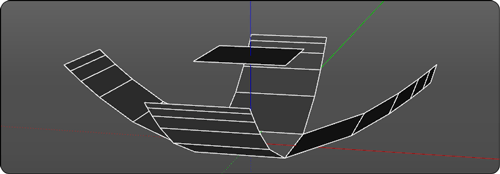
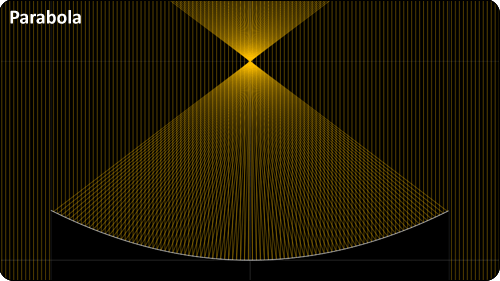
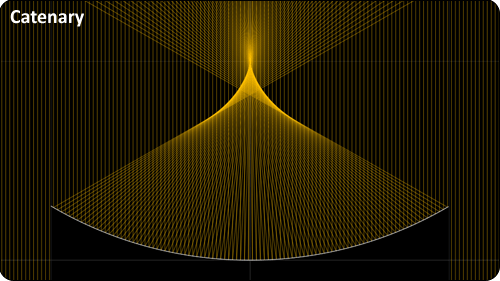
A solar trough is simply a long curved mirror that reflects sunlight onto a long heat-sink, usually a pipe. Parabolic troughs use the shape of a parabola as it focuses all incoming light to a single point. The down side (for me) is bending the mirror into an exact parabola and then maintaining that shape. Another shape that is similar to a parabola is called a catenary. A catenary is the shape that a sagging chain or cable makes. By using inexpensive aluminized mylar and suspending it along the sides I can let gravity create and maintain the correct shape for me. Unfortunately mylar is also very light, making it easily deformed by wind. One solution is to adhere long strips of material to the back side of the mylar to give it additional weight.
How effective is a catenary trough?
Even assuming I do make an inexpensive catenary trough that can stand up to the elements, how effective will it be at concentrating light? The answer depends on the parameters of the catenary- how deep it is and how wide it is. When both are shallow enough, the differences are negligible:
Software Side Effects:
R-Bench – A Windows QT4 application that models various shaped reflectors.
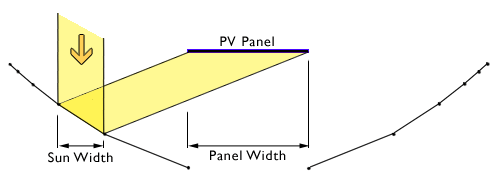 Shown above, the “sun width” is narrower than the panel itself: in the highlighted path it’s a ratio of 45 to 120 or about 37% original intensity. To compensate for this one can simply use a lot of mirrors- the diagram shows a total of 10 flat mirrors each at the correct angle and width to fully illuminate the panel. If we assume a square solar panel, it achieves about 3 times the sunlight of simply pointing the panel directly at the sun. Add ten more mirrors perpendicular to the set shown and you have a 6-fold concentration: